
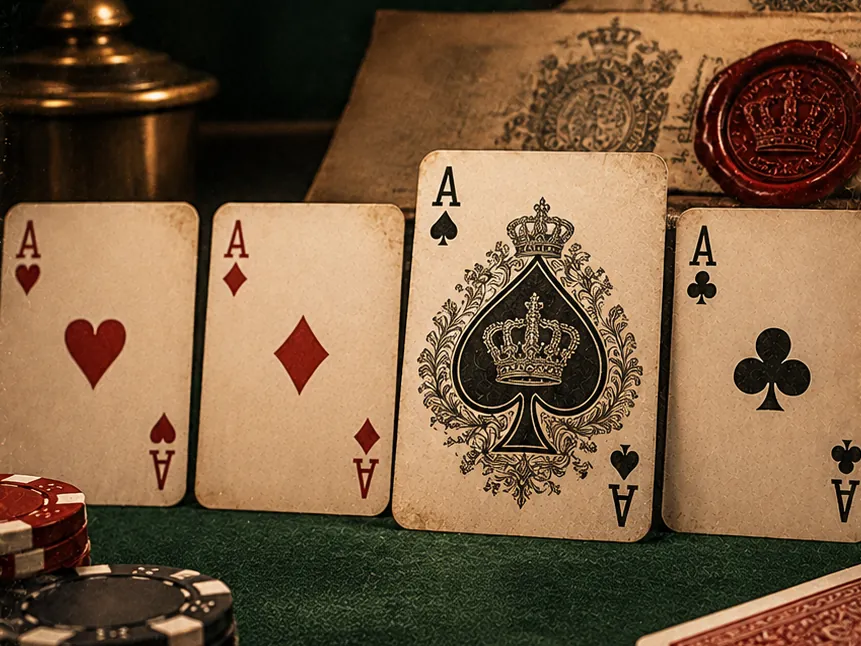
Short answer: the ace of spades used to be a tax stamp. England taxed playing cards from 1711, and from 1712 the proof of payment had to be on a card itself. The ace of spades won out. The ornate design was there to stop forgeries, and manufacturers have kept it ever since.
A tax on playing cards
In 1711, England introduced a duty on playing cards: sixpence a deck, evidenced by a seal on the wrapper. The problem with wrappers is that they end up in the trash. No wrapper, no evidence, and no evidence means no proof the tax was paid.
So from 1712 the law required the stamp on a card itself. At first it did not matter which one. The ace of spades won out, presumably for the least spectacular reason imaginable: it was on top of the stacked deck.
From a stamp to a government print
From 1765 the state went a step further and printed that one ace itself, with the royal coat of arms. Manufacturers received their aces from the tax office.
In 1828 came a particularly lavish version that looked more like a banknote than a playing card. In the trade it was called Old Frizzle. The curlicues were not about looks but about the same thing as on banknotes: protection against forgery.
Forging the ace of spades was a hanging offense
A forged ace of spades was no misdemeanor. It was the forgery of a tax stamp, and that carried the death penalty. The cardmaker Richard Harding, from the area around Grosvenor Square, was convicted of exactly that.
He was caught because the Stamp Office noticed that he bought conspicuously few stamps and sold conspicuously many decks. They sent the official printer out personally as a test buyer. Six packets of cards were enough. Harding was hanged on November 13, 1805.
Why the decoration survived
During the Napoleonic Wars the duty rose to two shillings and sixpence. Wars are expensive, and card players pay voluntarily. The tax was not abolished until 1960, when the administrative cost exceeded the revenue.
The requirement for an official ace of spades had already ended in 1862. Manufacturers could simply have left the space empty. They did not: they kept the ornamental panel and put their own name in it, because free advertising space is free advertising space. American decks adopted the habit, even though no such tax ever existed in the United States.
So the ace of spades in your hand is the facade of a government office that moved out in 1862.
Sources in the book: International Playing-Card Society, "The Ace of Spades"; Old Bailey Proceedings Online, R. v. Harding, September 18, 1805, ref. t18050918-62.